Back to Blog
System Design

Why AI-Native API Security Changes Everything: A Technical Evaluation of Cyron's Architecture

Examining Cyron.IO's 7-billion parameter reasoning engine running on mirrored traffic represents a fundamental shift in how we should think about API security.

Shreyans Bhatt

Solution Architect | Principal Engineer | CEH Certified

Why AI-Native API Security Changes Everything: A Technical Evaluation of Cyron's Architecture

APIs power modern applications. They also represent the largest unprotected attack surface in most organizations.

I have spent years designing enterprise systems where security was either an afterthought bolted on at the end, or a fortress of rules so complex that developers found creative ways around them. Neither approach works. The fundamental problem is that traditional security tools were built for a world where applications had clear boundaries, predictable traffic patterns, and human-speed interactions.

That world no longer exists.

Modern applications are collections of microservices communicating through APIs. A single user action might trigger dozens of internal API calls across multiple services. The attack surface is not a wall you can put a firewall in front of. It is a mesh of interconnected endpoints, each with its own authorization logic, data access patterns, and business rules.

When I evaluate security tools, I look for something specific: does this tool understand what the application is actually doing, or is it just pattern matching against known bad signatures? The difference matters more than most vendors want to admit.

Cyron's January 2026 release caught my attention because it represents an architectural approach I have been advocating for years. Let me explain why this matters by first examining what traditional tools get wrong.

The Fundamental Limitation of Network-Layer Security

Web Application Firewalls operate at Layer 7, but they think at Layer 4.

What I mean by this is that while WAFs technically inspect HTTP traffic, they do not understand the semantics of what that traffic represents. A WAF sees a POST request to /api/users/123/transactions. It checks if the payload contains SQL injection patterns, cross-site scripting vectors, or known attack signatures. If those checks pass, the request proceeds.

But here is what the WAF cannot answer: Should this user be accessing transactions for user 123? Is this the fifteenth time in ten minutes that someone has requested transaction data for sequential user IDs? Does this request pattern match how legitimate users actually interact with this endpoint?

These questions require context that exists outside the individual request. They require understanding of user behavior patterns, authorization boundaries, and business logic. Traditional security tools do not have access to this context because they were designed to inspect packets, not understand applications.

This gap is where attackers live. OWASP API Security Top 10 is dominated by issues that require contextual understanding: Broken Object Level Authorization, Broken Function Level Authorization, Excessive Data Exposure, Lack of Resources and Rate Limiting. None of these can be reliably detected by examining a single request in isolation.

Why API Security Requires a Different Architecture

Building effective API security requires rethinking the fundamental architecture. You cannot bolt intelligence onto a system designed for pattern matching. You need to start with a system designed for behavioral understanding.

This is where my evaluation of Cyron begins. Their architecture makes several choices that align with secure-by-design principles I consider essential for modern API protection.

Principle 1: Observe Without Disrupting

Cyron operates on mirrored traffic. Your production APIs never see Cyron in the request path. This is not a minor implementation detail. It is a fundamental architectural decision with significant implications.

When security tools sit inline with production traffic, they create a forcing function: every detection rule must be tuned to minimize false positives because false positives mean blocked legitimate requests. This pressure inevitably leads to conservative detection thresholds. Teams disable rules that generate too many alerts. The security tool becomes a lowest-common-denominator filter that catches obvious attacks and misses everything sophisticated.

Traffic mirroring eliminates this pressure. Cyron can run aggressive detection without risking production availability. If the analysis engine has a bug or a rule misfires, your APIs continue serving traffic normally. This separation allows for the kind of deep analysis that would be computationally prohibitive in the request path.

The January 2026 release emphasizes this with what they call "True Sidecar Architecture." The cyron-agent receives mirrored traffic without replacing or modifying existing proxies, load balancers, or networking infrastructure. Your infrastructure stays exactly as you built it. This is defence-in-depth implemented correctly: adding security layers without creating new single points of failure.

Principle 2: Multi-Stage Analysis with Graceful Degradation

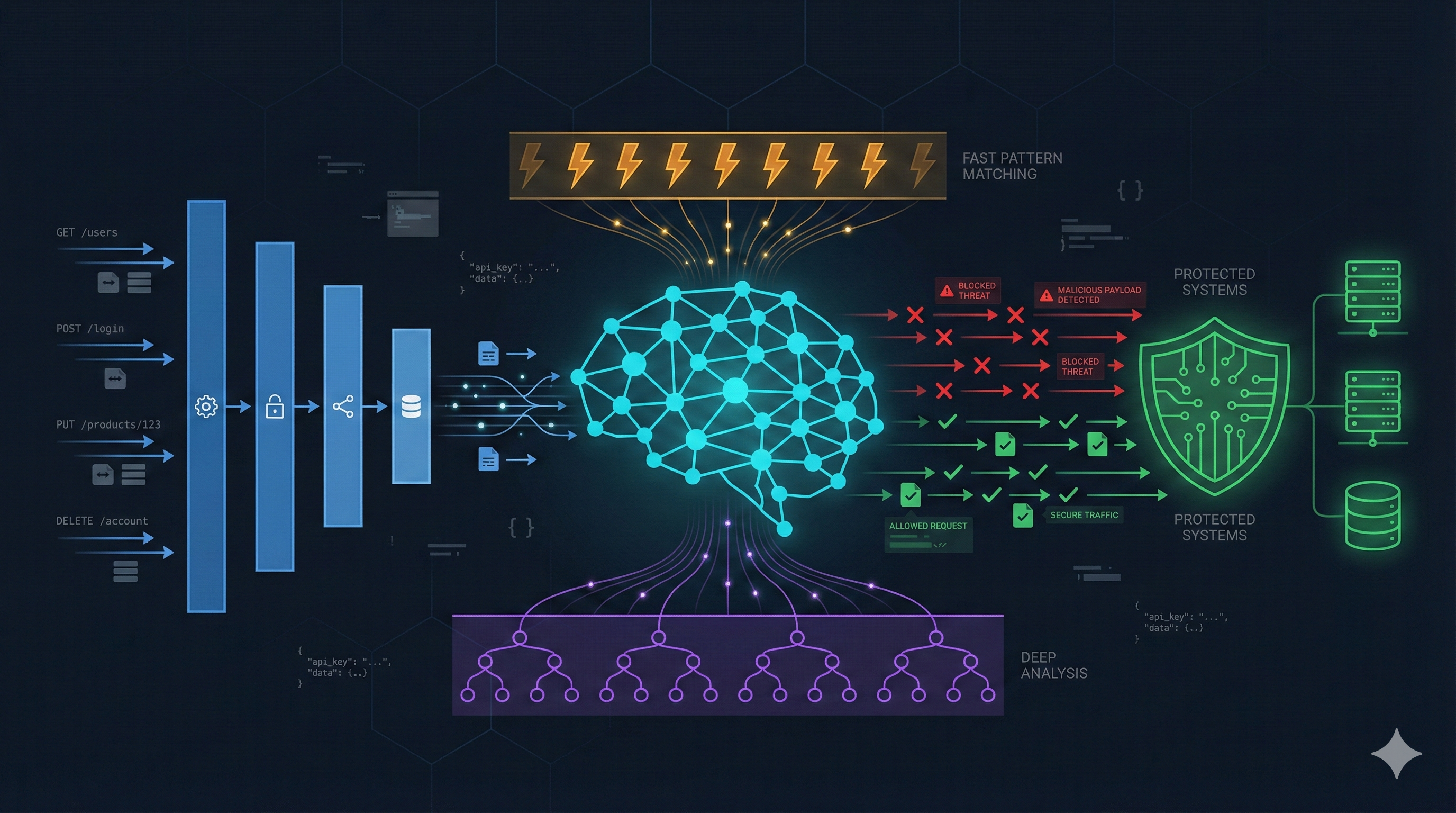
The detection pipeline Cyron describes follows a pattern I have implemented in various forms across high-throughput systems. The idea is simple but the execution is complex: use fast, cheap checks to handle clear cases, and reserve expensive analysis for genuinely ambiguous situations.

Their pipeline works like this:

Stage 1: Instant Detection handles known attack signatures in under 1 millisecond. This is your traditional pattern matching, but optimized for speed. If a request contains '; DROP TABLE users;-- in a parameter, you do not need sophisticated analysis to flag it.

Stage 2: ML Scoring uses ensemble models optimized for P99 latency. This is where things get interesting from an ML architecture perspective. P99 optimization means the system is designed for consistent performance on the slowest 1% of requests, not just average case. This matters enormously in production systems where tail latency spikes cascade into downstream timeouts.

Stage 3: Behavioral Analysis compares current requests against learned baselines for each API. What does "normal" traffic look like for this endpoint? How does this request deviate statistically?

Stage 4: Deep Reasoning engages only for ambiguous cases that passed earlier stages but warrant investigation. This is where the 7-billion parameter model operates.

The graceful degradation aspect is critical. Their release notes mention that if the AI reasoning engine is temporarily unavailable, rule-based fallback ensures continuous protection. This is defence-in-depth applied to the security system itself. The system does not fail open or fail closed in a binary way. It degrades to a less sophisticated but still functional protection layer.

Understanding the 7-Billion Parameter Decision

Let me spend some time on the AI architecture because this is where my background in LLM systems informs my evaluation.

Cyron uses a 7-billion parameter model for their deep reasoning stage. This number is not arbitrary, and understanding why they chose it reveals something important about how AI should be deployed in security contexts.

Why Not Larger?

Modern frontier models have hundreds of billions of parameters. GPT-4 class models are estimated at over a trillion parameters. Why would a security tool use a model that is orders of magnitude smaller?

The answer comes down to three factors: latency, cost, and deployment topology.

Latency: Larger models require more compute per inference. A 70B parameter model running on optimized hardware might take 500ms to generate a response. A 7B model can respond in 50-100ms on the same hardware. When you are analyzing API traffic, even asynchronous analysis needs to be fast enough to generate actionable alerts before an attack completes.

Cost: Inference costs scale roughly linearly with model size. Running a 70B model on every ambiguous request would make the economics untenable for most deployments. A 7B model hits a sweet spot where you can afford to run deep analysis on a meaningful portion of traffic.

Deployment Topology: This is the factor most people miss. Larger models require specialized hardware (high-end GPUs with substantial VRAM) and centralized deployment. A 7B model can run on more modest hardware, potentially enabling edge deployment closer to where traffic originates. This reduces round-trip latency and improves isolation between tenants.

Why Not Smaller?

If smaller is cheaper and faster, why not use a 1B or 2B parameter model?

The answer is capability. Security analysis requires understanding context, recognizing patterns that span multiple data points, and making nuanced judgments about intent. Smaller models lack the representational capacity to perform this reasoning reliably.

Cyron's release notes describe their model analyzing "ambiguous cases with full context" and understanding "intent, not just patterns." This kind of semantic understanding requires a certain minimum model capacity. Based on my experience with LLM benchmarks, 7B parameters is approximately the threshold where models begin to demonstrate reliable multi-step reasoning and contextual understanding.

The 7B choice represents the optimal point on the capability/cost curve for this specific use case: large enough to reason about complex attack patterns, small enough to run at scale without prohibitive latency or cost.

System 2 Thinking: Cognitive Architecture in Security Systems

Cyron brands their approach "System 2 Thinking" which references the dual-process theory from cognitive psychology. The concept, popularized by Daniel Kahneman, distinguishes between two modes of thinking:

System 1: Fast, automatic, intuitive. Handles familiar situations with minimal effort. This maps to Cyron's instant detection and ML scoring stages.

System 2: Slow, deliberate, analytical. Engages for novel situations requiring careful reasoning. This maps to their behavioral analysis and deep reasoning stages.

This is not just marketing terminology. It represents a genuine architectural pattern for building efficient AI systems.

The naive approach to AI-powered security would be to run the most sophisticated model on every request. This is computationally wasteful and introduces unnecessary latency. Most API traffic is either clearly legitimate or clearly malicious. You do not need a 7B parameter model to recognize that SELECT * FROM users WHERE id = 5 in a query parameter is probably SQL injection.

The sophisticated approach mirrors how human experts actually work. An experienced security analyst does not perform deep packet analysis on every request. They develop pattern recognition that instantly flags obvious issues, and they reserve careful analysis for genuinely unusual situations. The cognitive load of System 2 thinking is high, so experts deploy it selectively.

Cyron's architecture implements this cognitive pattern in software. The fast stages handle the 95%+ of traffic that does not require sophisticated analysis. The deep reasoning stage focuses computational resources on the small percentage of requests that are genuinely ambiguous.

This is why their claim of "sub-50ms P99 detection latency" is achievable despite using a large language model. Most requests never touch the LLM. The expensive inference only runs on escalated cases.

The Seven Intelligence Modules: Context-Aware Forensics

When Cyron's AI investigates a suspicious request, it does not analyze in isolation. The release notes describe seven specialized intelligence modules that provide context:

  1. Historical Correlation: Compares current request against past traffic patterns for this API
  2. Baseline Profiler: Knows what normal traffic looks like and measures deviation
  3. User Behavior Tracker: Understands how legitimate users interact with your APIs
  4. Authorization Auditor: Detects users accessing resources they should not see
  5. Attack Campaign Detector: Identifies coordinated attacks across your API surface
  6. Authentication Monitor: Spots credential abuse, brute force, and session anomalies
  7. Business Logic Guardian: Catches attempts to bypass intended application workflows

This modular architecture is significant because it means each intelligence capability can be developed, tested, and improved independently. It also means the deep reasoning model receives structured context rather than raw request data.

Let me explain why this matters with an example.

Suppose the system sees a request to /api/orders/54321/refund. Without context, this could be completely legitimate. With context from the Authorization Auditor, the system knows that the authenticated user does not own order 54321. With context from the User Behavior Tracker, it knows this user has never performed a refund before. With context from the Attack Campaign Detector, it knows there have been 47 similar requests in the past hour targeting different order IDs.

Each piece of context transforms the probability assessment. The raw request is ambiguous. The contextualized request is clearly an attack attempt.

This is Broken Object Level Authorization (BOLA) detection, which is the #1 vulnerability in OWASP API Security Top 10. Traditional WAFs cannot detect this because they lack the contextual modules that make detection possible.

Human-in-the-Loop Learning: Building a Feedback System

The January 2026 release introduces a feature that reflects a mature understanding of ML system operations: human-in-the-loop learning through false positive marking.

Here is why this matters from a systems perspective.

Every ML-based security system faces the cold start problem. The model ships with training based on general attack patterns, but your specific API traffic has characteristics the model has never seen. Legitimate traffic for your application might trigger patterns that looked suspicious in the training data.

The traditional approach is to wait for engineering to retrain the model. This creates a delay measured in weeks or months between identifying a false positive pattern and fixing it. During that time, your security team either ignores alerts (degrading security) or manually triages the same false positive repeatedly (wasting resources).

Cyron's approach closes this loop directly. Security analysts mark false positives through the dashboard. This feedback immediately influences the risk scoring for that API endpoint. Over time, the accumulated feedback trains improved detection models.

The release notes describe the learning areas affected:

  • Pattern Recognition: Similar request patterns become less likely to trigger alerts
  • Behavioral Models: Baseline understanding of "normal" traffic gets refined
  • AI Context: Future investigations include false positive history for better judgment
  • Risk Calibration: API reputation scores become more accurate over time

This is supervised learning integrated into operational workflow. Your security team is not just triaging alerts; they are training the system. Each false positive marking is a labeled data point that improves future accuracy.

The audit trail aspect is equally important for enterprise deployment. Compliance requirements often mandate documentation of security decisions. Having a complete record of who marked what and when transforms this operational data into compliance evidence.

Intelligent Alert Suppression: Solving Alert Fatigue

Alert fatigue is one of the most pernicious problems in security operations. When analysts see too many alerts, they become desensitized. The critical alert gets lost in the noise. Studies consistently show that alert volumes above certain thresholds lead to decreased detection rates, not increased security.

Cyron's approach to this problem is straightforward but requires sophisticated implementation: when an API endpoint is identified as critically compromised and an incident has been created, duplicate alerts are automatically suppressed.

The key insight is that the original incident serves as the case record. Subsequent alerts about the same compromised endpoint do not provide new information. They just create noise.

This seems obvious in retrospect, but implementing it correctly requires tracking state across the detection pipeline. The system needs to know:

  • Which endpoints have active incidents
  • What constitutes a "duplicate" versus a new attack vector
  • When to re-enable monitoring after incident resolution
  • How to maintain forensic access to suppressed data for investigation

The release notes indicate that complete historical data remains available for investigation. This is crucial. Suppression affects alerting, not data collection. If an analyst needs to understand the full scope of an attack, the data is there.

The dynamic risk assessment feature complements this. API risk scores evolve based on ongoing activity:

  • Confirmed threats increase risk scores toward critical thresholds
  • Human-marked false positives reduce risk scores
  • Clean traffic gradually restores healthy status

This creates a self-correcting system where risk assessment adapts to observed reality rather than remaining static based on initial configuration.

Integration Architecture: Meeting Teams Where They Are

Security tools that require infrastructure overhaul do not get deployed. This is a practical reality that Cyron's architecture explicitly addresses.

The January 2026 release expands integration options significantly:

Container Orchestration:

  • Docker Compose sidecar deployment alongside existing services
  • Kubernetes native sidecar container with Helm chart support
  • Multi-architecture support for AMD64 and ARM64 (covering Apple Silicon and AWS Graviton)

Windows Server:

  • Native Windows Service installation through standard service manager
  • NuGet packages for ASP.NET Core and ASP.NET Framework applications

Proxy Integration:

  • OpenResty/Lua for full request and response capture
  • Standard nginx for environments with Lua restrictions

This breadth of integration options reflects understanding of enterprise reality. Most organizations have heterogeneous infrastructure. Some services run in Kubernetes, others on bare metal Windows servers, others behind various proxy configurations. A security tool that only supports one deployment model creates coverage gaps.

The "True Sidecar Architecture" design philosophy means cyron-agent receives mirrored traffic without modifying existing infrastructure. Your load balancer, proxy, and API gateway continue operating exactly as configured. Cyron adds a parallel path for security analysis without inserting itself into the critical path.

This is defence-in-depth applied to deployment architecture. If Cyron has a problem, your production traffic is unaffected. The security layer can be added, removed, or upgraded without touching production routing.

OCSF Format and Cryptographic Signatures: Enterprise Integration Done Right

The release notes mention OCSF-format webhooks with cryptographic signatures for SIEM delivery. This detail deserves attention because it reveals maturity in enterprise security tool design.

OCSF (Open Cybersecurity Schema Framework) is a standardization effort to create consistent event formatting across security tools. When your SIEM receives events from ten different security products, each with its own schema, correlation becomes a nightmare. OCSF adoption means Cyron events can be ingested alongside other compliant tools without custom parsing.

Cryptographic signatures on webhooks address a real attack vector: if an attacker compromises a network segment where security alerts transit, they could potentially inject false alerts or suppress real ones. HMAC-SHA256 signatures allow the receiving SIEM to verify that alerts actually originated from Cyron and have not been tampered with.

These are not features that make marketing slides. They are features that determine whether enterprise security teams can actually deploy and operate the tool effectively.

What This Means for Security Architecture

Let me step back and articulate what Cyron's architecture represents in the broader context of security systems design.

The Shift from Signature to Semantics

Traditional security operates on signatures: known patterns that indicate known attacks. This approach has an inherent limitation. It only catches attacks that match patterns someone has already identified and encoded.

Semantic security operates on understanding: what is this request trying to accomplish, and should this user be allowed to accomplish it? This requires contextual awareness that signatures cannot provide.

Cyron's architecture is built for semantic security. The seven intelligence modules, the behavioral baselines, the deep reasoning model that evaluates intent. These are not signature matching systems with AI branding. They are fundamentally different tools solving fundamentally different problems.

The Acceptance of Uncertainty

Traditional security tools try to make binary decisions: allow or block, safe or malicious. This framing forces false certainty. The reality is that most security decisions involve uncertainty.

Cyron's multi-stage pipeline explicitly acknowledges uncertainty. Requests can be clearly safe, clearly malicious, or ambiguous. Ambiguous requests escalate to more sophisticated analysis. Even after analysis, the system maintains risk scores rather than binary verdicts.

This probabilistic approach matches how security actually works. An experienced analyst does not think in binary allow/block terms. They think in terms of risk levels, confidence intervals, and investigation priorities. Security tools should operate the same way.

The Integration of Human Expertise

The human-in-the-loop learning feature represents something important: acknowledgment that AI systems improve through human guidance. The model is not a replacement for human security expertise. It is an amplifier of that expertise.

Every false positive marked by an analyst trains the system. Over time, the accumulated judgment of your security team becomes embedded in the detection model. The system becomes specifically adapted to your environment, your traffic patterns, your threat profile.

This is how AI should be deployed in high-stakes domains. Not as an autonomous decision maker, but as a tool that extends human capability while remaining guided by human judgment.

Practical Implications for Adoption

If you are evaluating Cyron or similar AI-native security tools, here are the questions I would ask:

1. What is your escalation path?

Understand how requests move through the detection pipeline. What percentage of traffic actually reaches the deep reasoning stage? What happens when the AI component is unavailable?

2. How does the learning loop work?

Can your security team provide feedback that influences detection? How quickly does that feedback affect behavior? Is there audit trail for compliance?

3. What context does the AI receive?

Raw request analysis is insufficient. What contextual modules provide information to the reasoning engine? How are behavioral baselines established and updated?

4. How does integration work with your specific stack?

Verify that the sidecar agent supports your deployment topology. Test mirroring configuration in a staging environment before production deployment.

5. What are the latency characteristics?

Async analysis on mirrored traffic eliminates inline latency, but you still need alerts to arrive before attacks complete. Understand the end-to-end time from request to alert under various load conditions.

Conclusion

API security is not a solved problem. The attack surface is expanding, the attacks are becoming more sophisticated, and traditional tools are fundamentally limited by their architectural assumptions.

Cyron's January 2026 release represents an approach aligned with how modern API security should work: semantic understanding over signature matching, contextual awareness over isolated analysis, human-guided learning over static rules.

The 7-billion parameter reasoning engine is not the point. The point is an architecture designed for the reality of API security: high-volume traffic, sophisticated attackers, complex authorization logic, and the need for continuous improvement.

Whether Cyron specifically fits your environment depends on factors I cannot evaluate from release notes: integration complexity with your specific stack, performance under your specific traffic patterns, operational overhead for your specific team size.

But the architectural approach is sound. If you are serious about API security, you should be evaluating tools built on these principles.

The attack surface is not shrinking. Your defenses need to evolve.


Shreyans is a Principal Solution Architect specializing in AI, cybersecurity, and enterprise systems design. He writes about secure architecture patterns and emerging security technologies at shreyans.systems.


References and Further Reading

Tagged with:

#API Security #AI Security #LLM Architecture #Secure-by-Design #Defence-in-Depth #DevSecOps #OWASP